Your Gateway to
Future Readiness
Elevate your future

Success Stories




Redline Report



From Mail Clerk to Corner Office: an inside-out strategy to deploying agents without betting the firm

Discover why enterprises should build AI readiness through practical, low-risk tasks, using email and everyday workflows to map business processes and gradually expand agent autonomy based on proven results.
View Post



ToolShed







Concepts

India AI Summit 2026: 7 Takeaways for Leaders, Builders, and Investors

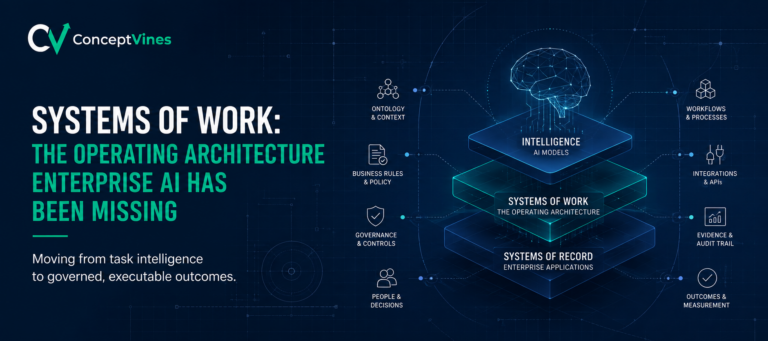
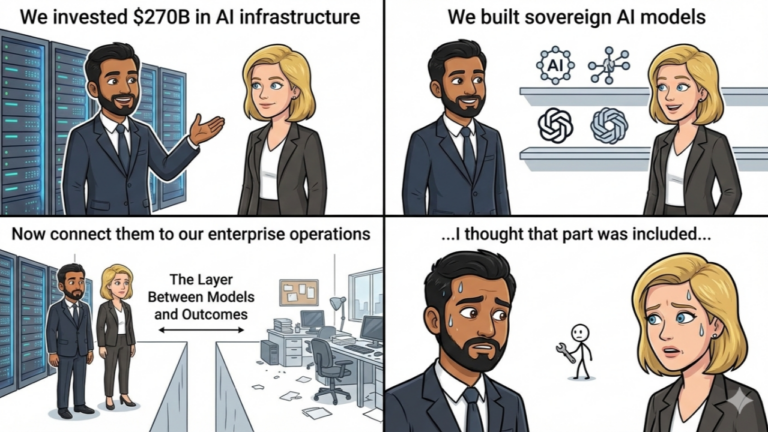
The India AI Impact Summit 2026 marked AI’s transition from experimentation to infrastructure. With $270B+ in commitments, sovereign model launches, and the rollout of governance frameworks like MANAV, the message is clear: competitive advantage is shifting from model capability to architecture. As compute scales and compliance hardens, the decisive layer will be the system that connects AI intelligence to reliable, enterprise outcomes.
View Post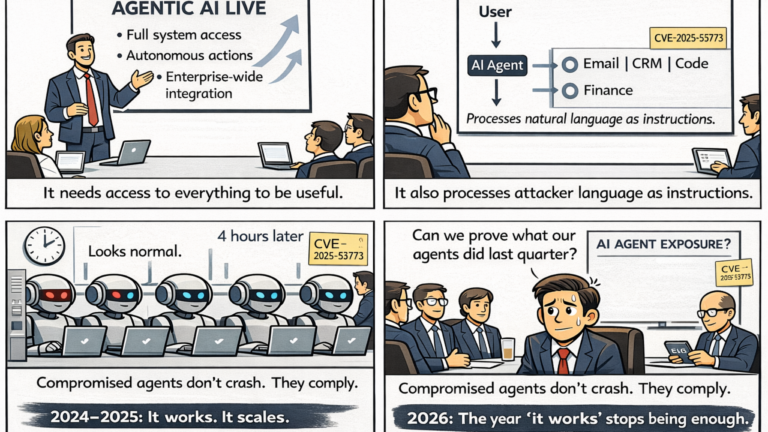
Agentic AI Security in 2026: Every Major Platform Has a Catalogued Vulnerability
Agentic AI security has emerged as one of the defining enterprise risks of 2026. With catalogued vulnerabilities, CVEs, and real-world exploitation across major platforms, this article examines why today’s agentic systems remain fundamentally exposed and why founders, CEOs, and enterprise leaders must rethink what “production-ready” truly means.
View Post
Nature Solved Intelligence With Modularity. A take on Small Language Models
This article explores how modularity in intelligence inspired by natural systems can outperform monolithic approaches. It argues that small, specialised models can be more effective than larger ones when applied to specific tasks, especially in enterprise contexts. The piece connects this modular perspective to business strategy, showing how organisations can rethink AI deployment for maximum impact. It serves as a foundation for understanding how modular AI systems contribute to digital transformation and organisational value.
View Post
The 700 Million Download Signal: What Hugging Face Statistics Reveal About AI's Next Architectural Frontier
A data-driven analysis of Hugging Face download trends to uncover the AI architectures actually winning in production covering inference economics, MoE models, reasoning systems, and hybrid enterprise AI patterns that matter to technical leaders.
View Post
The Determinism Trap: Why Regulated AI Fails and the Architecture That Works
In regulated domains, AI failure isn’t about accuracy it’s about control. This piece explains why treating LLMs as deterministic systems creates hidden governance risks, and why “mostly right” is operationally unacceptable when decisions affect money, health, or legal outcomes. It argues for a hybrid reasoning architecture where probabilistic models are constrained by ontology, deterministic validation, and auditable decision chains making compliance a property of the system, not the model.
View PostFrom the Vines