
If you build systems that touch money, health, eligibility, safety, or legal outcomes, this topic isn’t academic, it’s operational survival. In regulated environments, the cost of a “mostly right” system isn’t a slightly worse user experience. It’s liability, sanctions, reputational damage, and forced shutdowns. And the trap is subtle: teams often treat LLMs as if they are a new kind of software library something you can lock down with configuration, certify with a test suite, and assume will behave the same way tomorrow. That assumption quietly breaks the moment an LLM starts producing policy-inconsistent answers, non-reproducible decisions, or confident fabrications. The result is predictable: organizations don’t fail because they “used AI.” They fail because they built the wrong kind of system around it.
Part 1 – The determinism trap is a category error, not an engineering mistake
Most enterprises were trained by decades of deterministic systems. Input X produces Output Y. If it fails, you can replay the execution, trace the branch, and prove what happened. Regulated industries went further: they built governance, audits, and accountability on the expectation that the system is reproducible and explainable in a stable way.
LLMs don’t live in that universe. They are probabilistic generators operating over distributions, and they run in serving stacks where performance optimizations, batching, and upgrades can change outputs in ways the end user cannot observe and the enterprise cannot easily control. Even when you do everything “right” in the common playbook temperature set to zero, prompts held constant you’re still not buying what boards mean when they say “deterministic.” You’re buying a hope that variation is small enough to ignore, until it isn’t.
The consequence isn’t merely technical. It’s governance. When a customer, regulator, or judge asks, “Why did this happen?” they are not asking for a plausible-sounding narrative. They are asking for a reconstructable chain: what inputs were used, what policy applied, what evidence was consulted, what constraints fired, and which authority produced the final decision. A system that cannot reliably produce that chain does not merely “lack explainability.” It lacks defendability.
Part 2 – The real failures aren’t just “bad prompts.” They’re mismatched guarantees
A lot of the public disasters you describe come from a single misunderstanding: people expect search-engine guarantees from generative systems, and deterministic governance from probabilistic engines.
Legal is the cleanest example because the failure is obvious. Lawyers cited cases that never existed, with fabricated quotes and citations. Courts sanctioned them. And the reason it keeps happening isn’t simply carelessness. It’s that the interface made the tool feel like research, but the underlying mechanism was generation. When someone asks, “How many times has this happened?”, Damien Charlotin’s tracker exists precisely because the pattern became large enough to document systematically. Your “713” number matters less than what it represents: this is no longer a rare edge case, it’s a recurring failure mode of treating generation as retrieval.
Healthcare and benefits systems demonstrate the heavier version of the same misunderstanding. Here the output isn’t a fake citation; it’s a denial, a debt notice, a reduced length of stay, a flagged fraud claim actions that alter lives. These systems fail catastrophically when probabilistic judgments are allowed to behave like final decisions without deterministic guardrails, without stable reasoning traces, and without safe escalation paths. In these domains, “close enough on average” is not a comfort. The harm happens in the tails, in the exceptions, in the people your model least understands, and in the drift you didn’t notice until the audit arrived.
The core point you’re making is right and it should be stated plainly: regulated environments don’t primarily punish non-determinism. They punish systems that cannot demonstrate control. What collapses projects isn’t the fact that the model is probabilistic; it’s that the architecture pretends the model can provide guarantees it was never designed to provide.
Part 3 – The way forward is hybrid reasoning, and ontology is the control surface
The winners in regulated AI will not be the teams with the most advanced LLM. They’ll be the teams with the most disciplined reasoning architecture.
A modern enterprise system needs to treat probabilistic intelligence as one component inside a governable machine. Let the LLM do what it’s good at: reading messy text, extracting intent, synthesizing context, proposing options, drafting explanations. But never confuse that with the source of truth, and never let it be the final authority where compliance requires reproducibility.
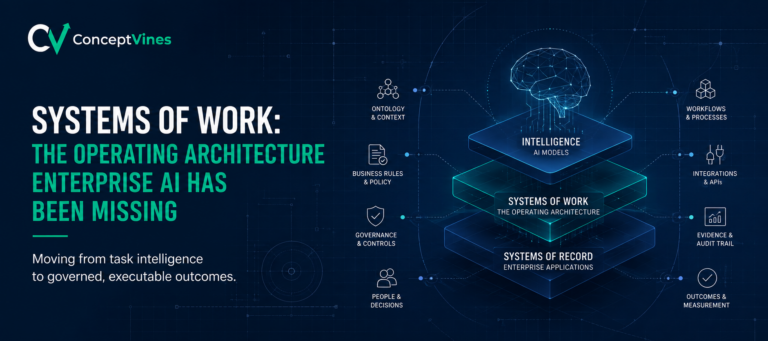
The missing layer is the one most teams skip: a formal meaning layer that the entire system can share. That is exactly what ontology delivers. Ontology turns fuzzy language into explicit domain objects and relations, so “what the user meant” is not an interpretive vibe inside the model it becomes a structured, testable representation. It defines what counts as a valid claim, what evidence is acceptable, what actions are permitted, what policies apply, and what constraints must never be violated. It becomes the contract between the probabilistic world of language and the deterministic world of governance.
Once you anchor an agent in an ontology, hybrid reasoning stops being a philosophy and becomes an implementation pattern. The agent can propose intent and plans, but every step must bind to defined concepts. Every plan must pass deterministic validation. Every claim must be backed by retrieved evidence. Every decision must produce an audit bundle that can be replayed. When something fails, the failure mode is designed: the system asks a clarifying question, retrieves missing evidence, escalates to a human, or refuses safely. Not because “we hope the model behaves,” but because the architecture forces the behavior.
Closing Notes
That’s the conclusion worth landing hard: your LLM will never be deterministic in the way regulated industries historically expect and that isn’t the problem. The problem is building systems as if it were. The path forward is to make determinism a property of the system, not the model. Ontology provides the shared meaning that makes actions and decisions legible. Hybrid reasoning provides the enforcement plane that makes those actions compliant. Agentic AI without ontology and deterministic guardrails is improvisation at scale. Ontology-grounded, hybrid-reasoning agentic AI is what turns probabilistic intelligence into something enterprises can actually trust, audit, and keep in production.